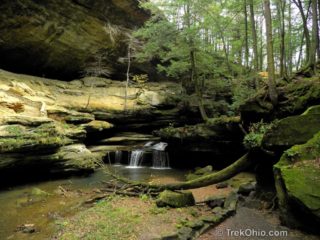
 The Hocking Hills is one of the most scenic areas in the state of Ohio. It is also a hiker's paradise with trails varying in difficulty from relatively easy ones (appropriate for young children) to more challenging trails that cover steep terrain or follow gorge rims.
State Park Trails
Old Man's Cave
The most popular place in the Hocking Hills is Old Man's Cave. By starting at the upper falls, you can follow a 1/2 mile loop crossing the creek downstream and see the various waterfalls, Read more ➜
The Hocking Hills is one of the most scenic areas in the state of Ohio. It is also a hiker's paradise with trails varying in difficulty from relatively easy ones (appropriate for young children) to more challenging trails that cover steep terrain or follow gorge rims.
State Park Trails
Old Man's Cave
The most popular place in the Hocking Hills is Old Man's Cave. By starting at the upper falls, you can follow a 1/2 mile loop crossing the creek downstream and see the various waterfalls, Read more ➜ Hocking Hills: Overview of the Hiking Trails
The Hocking Hills is one of the most scenic areas in the state of Ohio. It is also a hiker's paradise with trails varying in difficulty from relatively easy ones (appropriate for young children) to more challenging trails that cover steep terrain or follow gorge rims.
State Park Trails
Old Man's Cave
The most popular place in the Hocking Hills is Old Man's Cave. By starting at the upper falls, you can follow a 1/2 mile loop crossing the creek downstream and see the various waterfalls, Read more ➜ 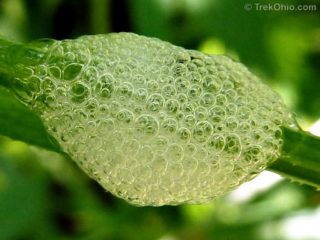 While we were hiking at Caesar Creek Gorge State Nature Preserve, I happened across this frothy, little mess.
I had previously encountered this bubbly stuff on grass.
It turns out that this is the work of a spittlebug, and you are looking at his spittle.
Okay, it's not exactly spittle. The spittlebug youngsters (called nymphs) tap into plants and suck their sap. According to this Wikipedia article, while consuming sap the nymphs use the "excess, filtered fluids" to produce
While we were hiking at Caesar Creek Gorge State Nature Preserve, I happened across this frothy, little mess.
I had previously encountered this bubbly stuff on grass.
It turns out that this is the work of a spittlebug, and you are looking at his spittle.
Okay, it's not exactly spittle. The spittlebug youngsters (called nymphs) tap into plants and suck their sap. According to this Wikipedia article, while consuming sap the nymphs use the "excess, filtered fluids" to produce 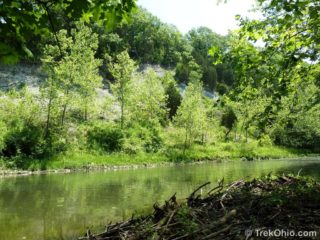 Caesar Creek Gorge State Nature Preserve is located in Oregonia, Ohio just west of Caesar Creek State Park and Caesar Creek Wilderness Area. The nature preserve is downstream from the dam located within the state park. We decided to hike the 2.25-mile trail at Caesar Creek Gorge State Nature Preserve because the preserve's official site stated that the cliff walls making up the gorge rise some 180 feet (54.9 m) above Caesar Creek. The cliffs were formed when huge volumes of torrential, meltwater
 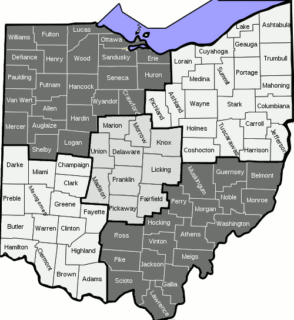 The TrekOhio Guide is designed to help you find interesting, natural sites in Ohio. We wanted to create a place online where you could learn about sites that were in the same geographical region regardless of whether the park, nature preserve or trail was managed by the federal government, the state government, a county government, or a non-governmental agency. In addition we wanted the information to be accessible via your cellphone or other mobile device, so it would be easy to adjust your
 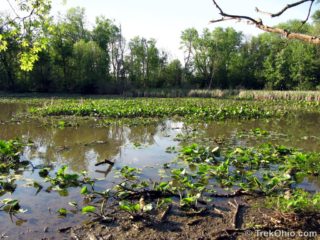 Boyer Nature Preserve is wonderful, mini-wetland that sits in the middle of suburban Westerville, Ohio. The site's main feature is its stream-fed pond. Although it may look like an ordinary pond, it's actually very special due to the way that it was formed. During the last ice age, Westerville was beneath approximately one thousand feet of ice (305 m). As the climate warmed, a large fracture formed near the edge of the melting glacier. Once that fracture became large enough, a huge slab of ice separated
 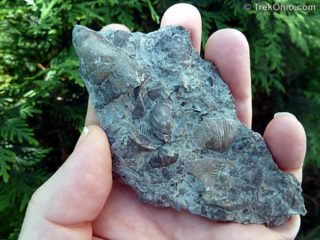 This past weekend, Bob and I went to Caesar Creek State Park to do a little hiking. However once we got there, we happened upon this amazing spillway that was just full of fossils.
In case you are wondering, this is basically a gigantic ditch. The Army Corps of Engineers constructed it to safely channel water from the Caesar Creek Reservoir in the event of flooding. The floor and one wall of the spillway consists of limestone and shale bedrock (dolomite).
The bare bedrock
This past weekend, Bob and I went to Caesar Creek State Park to do a little hiking. However once we got there, we happened upon this amazing spillway that was just full of fossils.
In case you are wondering, this is basically a gigantic ditch. The Army Corps of Engineers constructed it to safely channel water from the Caesar Creek Reservoir in the event of flooding. The floor and one wall of the spillway consists of limestone and shale bedrock (dolomite).
The bare bedrock 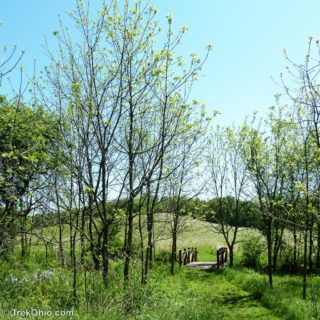 Knox woods State Nature Preserve is a small, 30 acre woodland with two loop trails. However there are several connector trails to the adjoining Knox County park, Wolf Run Regional Park. Wolf Run is a 288 acre park with diverse habitats (woods, meadows, wetlands) and many facilities for guests. Besides having an enclosed dog park, guests are also allowed to take their leashed dogs on the trails at Wolf Run. Because the park and preserve are next to each other, you can go on a great hike that takes
 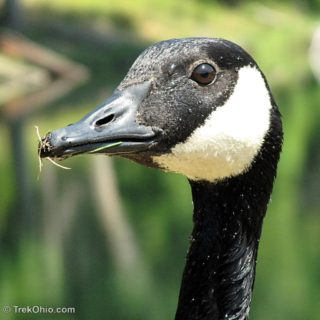 I have had the good fortune of vacationing in Canada on a couple of occasions, and one thing that became immediately clear to me is that Ohio has way more Canada Geese than Canada has. It's possible to go an entire day in Canada and not even see a Canada Goose. Let's see you manage that in Ohio!
Given that Ohio appears to be the center of the Canada Geese population, I suggest that we rename them Ohio Geese, or since Ohioans go by the nickname, "Buckeyes," maybe we could call them Buckeye Geese.
My
I have had the good fortune of vacationing in Canada on a couple of occasions, and one thing that became immediately clear to me is that Ohio has way more Canada Geese than Canada has. It's possible to go an entire day in Canada and not even see a Canada Goose. Let's see you manage that in Ohio!
Given that Ohio appears to be the center of the Canada Geese population, I suggest that we rename them Ohio Geese, or since Ohioans go by the nickname, "Buckeyes," maybe we could call them Buckeye Geese.
My 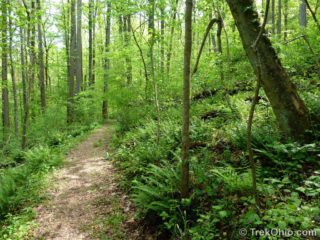 Wahkeena Nature Preserve is a hidden gem located in the SE corner of Fairfield County. The preserve lies just beyond the farthest point of glacial advance at the peak of the ice age. The word, "Wahkeena" is an Indian word meaning, "most beautiful." Given the variety of flowering shrubs and plants (including eight varieties of native orchids), this seems a very fitting name. You will see a brown sign for Wahkeena on US 33 as you head into the Hocking Hills. Wahkeena is well worth a detour.
As
Wahkeena Nature Preserve is a hidden gem located in the SE corner of Fairfield County. The preserve lies just beyond the farthest point of glacial advance at the peak of the ice age. The word, "Wahkeena" is an Indian word meaning, "most beautiful." Given the variety of flowering shrubs and plants (including eight varieties of native orchids), this seems a very fitting name. You will see a brown sign for Wahkeena on US 33 as you head into the Hocking Hills. Wahkeena is well worth a detour.
As 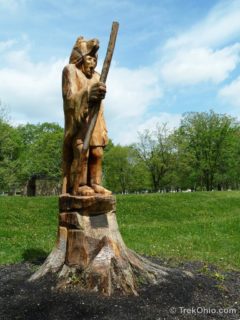 Overview
The Newark Earthworks were constructed about 2000 years ago by the prehistoric, Hopewell people. These are the largest, geometric earthworks in the world. To give you a better sense of the size and shape of these structures, it's best to look at an aerial view. Since I can't take aerial photos myself, I photographed some of the interpretive signs near the earthworks.
The plaque below shows the layout of the Newark Earthworks which occupy four square miles (10.6 square kilometers).
I
Overview
The Newark Earthworks were constructed about 2000 years ago by the prehistoric, Hopewell people. These are the largest, geometric earthworks in the world. To give you a better sense of the size and shape of these structures, it's best to look at an aerial view. Since I can't take aerial photos myself, I photographed some of the interpretive signs near the earthworks.
The plaque below shows the layout of the Newark Earthworks which occupy four square miles (10.6 square kilometers).
I