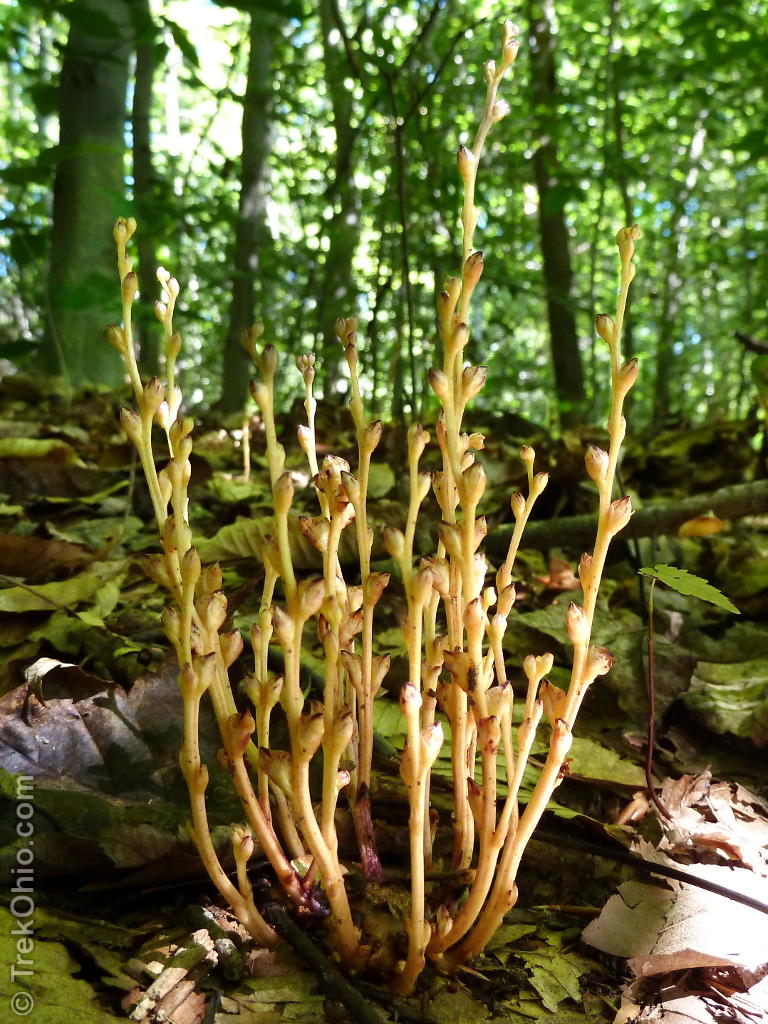
Most plants are green because of their chlorophyll which both tints their leaves and allows them to manufacture their own nutrition. However there are plants without chlorophyll; these plants aren’t green, nor do they have leaves. So they turn to other living things to meet their nutritional needs. There are two categories of plants without chlorophyll depending on whether the plant directly gets its nutrition from another plant, or indirectly via a fungus which in turn gets its food from a plant. Those plants that directly “feed” off other plants are parasites. The beechdrops pictured above are examples of such parasitic plants. Beechdrops get their food by tapping into the roots of their host plant, the American Beech tree.
In the photo below you see both a cluster of reddish beechdrops in the lower left. Their host plant, as American Beech tree, in the upper right. Underneath the ground the beechdrops have fastened onto this beech tree’s roots using special structures called haustoria.
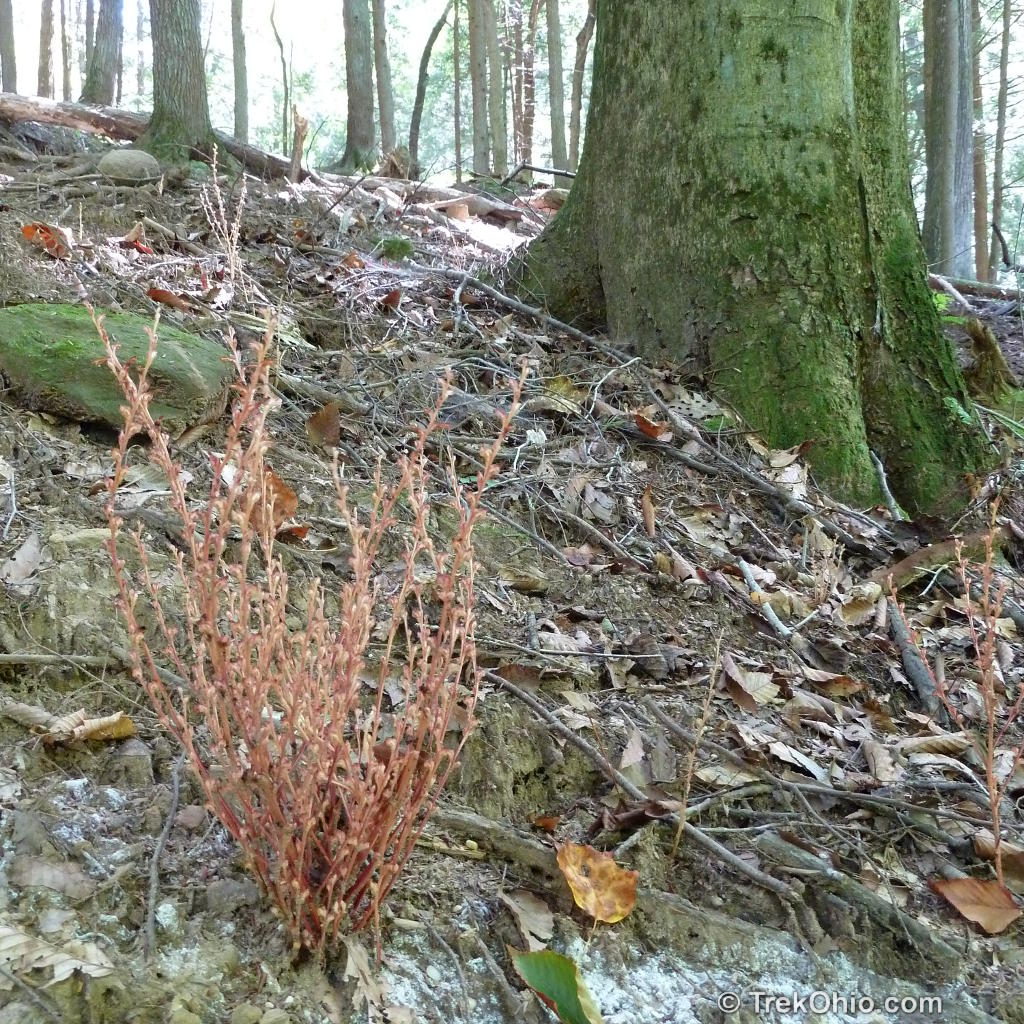
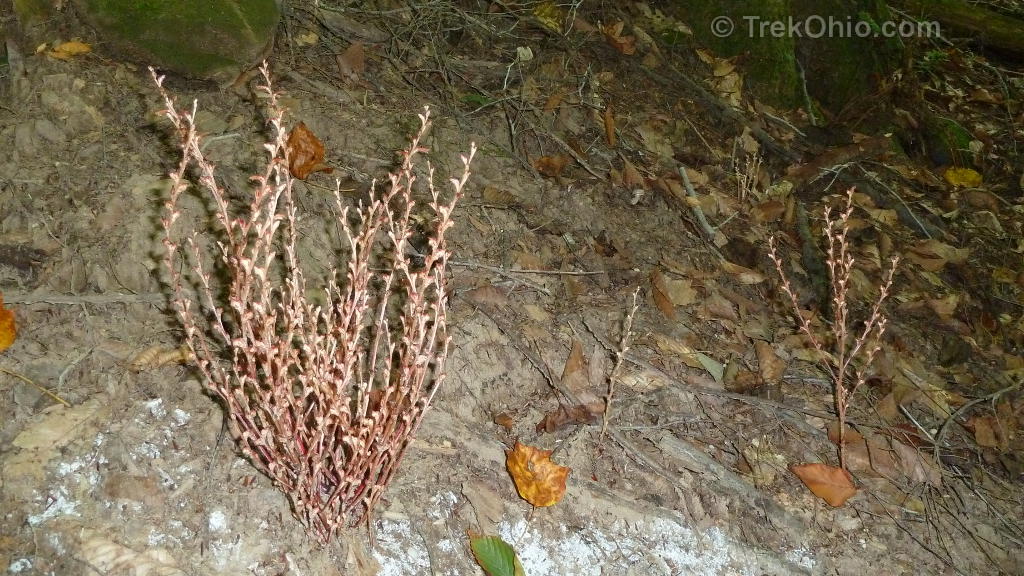
While strolling through the woods, beechdrops are easy to miss. They vary from creamy white to brown with red or brown accents. The fact that there is such a large cluster in the above photo helps to catch one’s eye. But there are actually other beechdrops in this same photo that you probably didn’t notice. Here’s a photo of the same area that has been illuminated with my camera’s flash. To the left you see the same cluster of flowers as seen above. However in the lower, middle of the photo you can now make out a single spike of flowers; to the far right there is a single, branching spike of flowers.
Beechdrops begin blooming in late August and continue through October. By the end of November the flowers look like dried up sticks. In their dried form, they can persist into the winter, rising above the snow.
In the above photos, the beechdrops have a reddish tint. Below are some brown beechdrops.
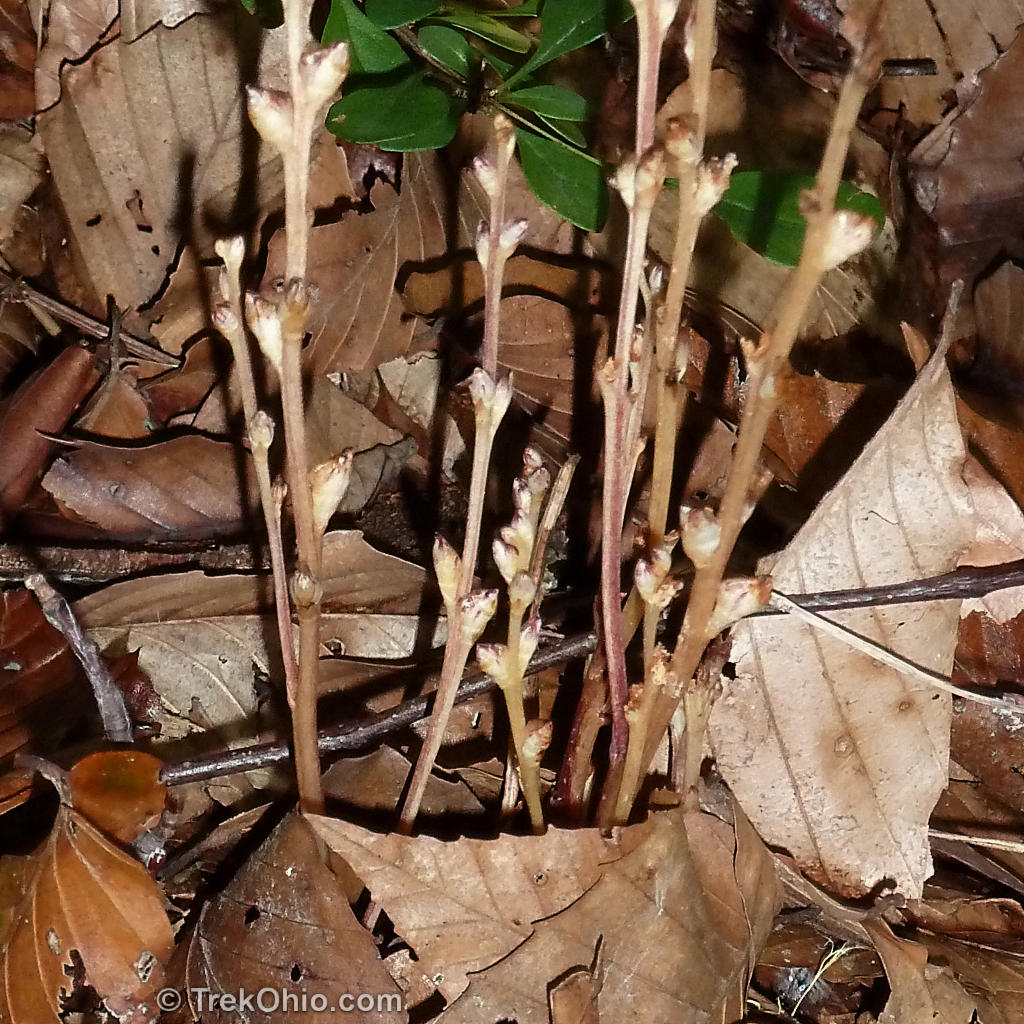
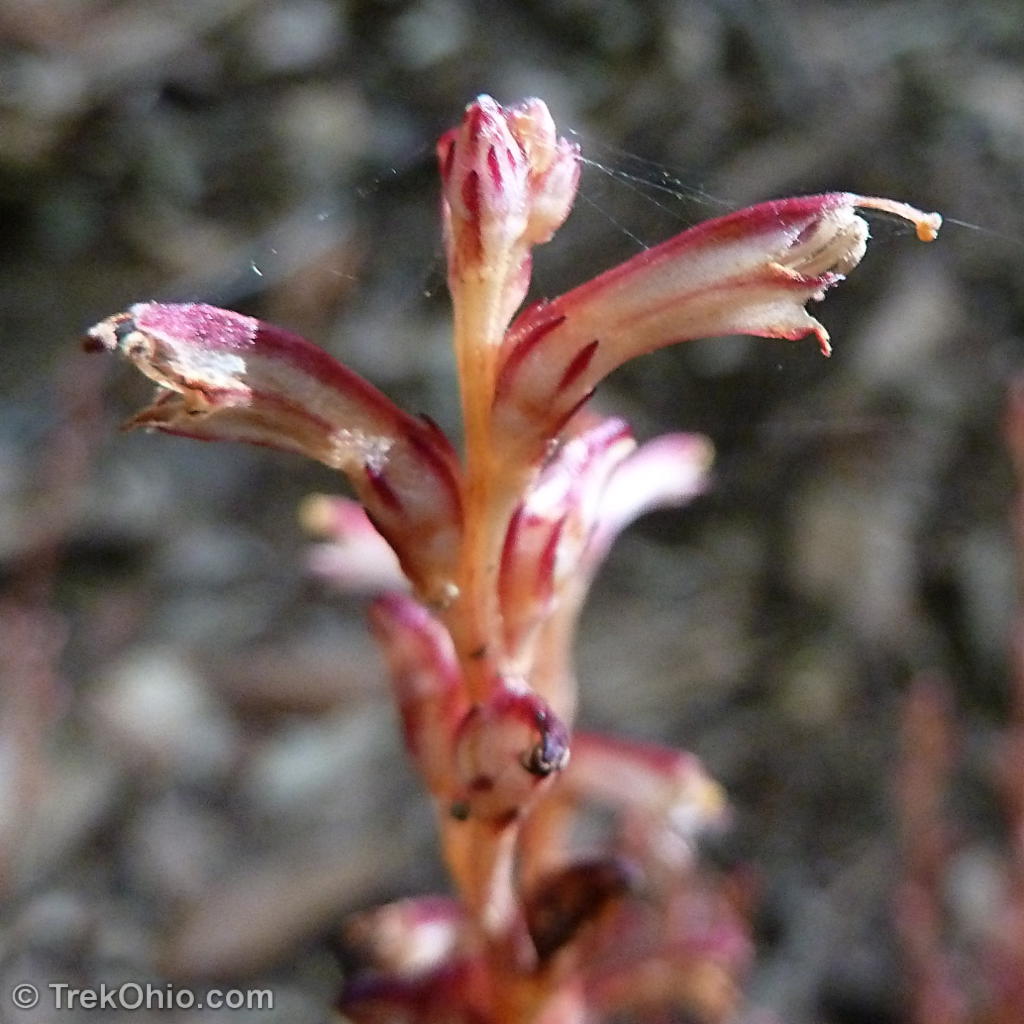
In the brown photo above, I was focusing on the lower portion of the flower spikes. It turns out that the lower flowers never open, so they can’t be pollinated by insects. It is possible that these closed flowers self-pollinate (a process called Cleistogamy). In the topmost photo of this post, the tubular flower is open. Such open flowers would be receive pollen from other open flowers when visited by insects (a process called Chasmogamy). Some people believe that all the beechdrop’s seeds originate from their open flowers. Rainfall disperses the seeds.
The final color variant of the flower is a creamy white, as seen below.
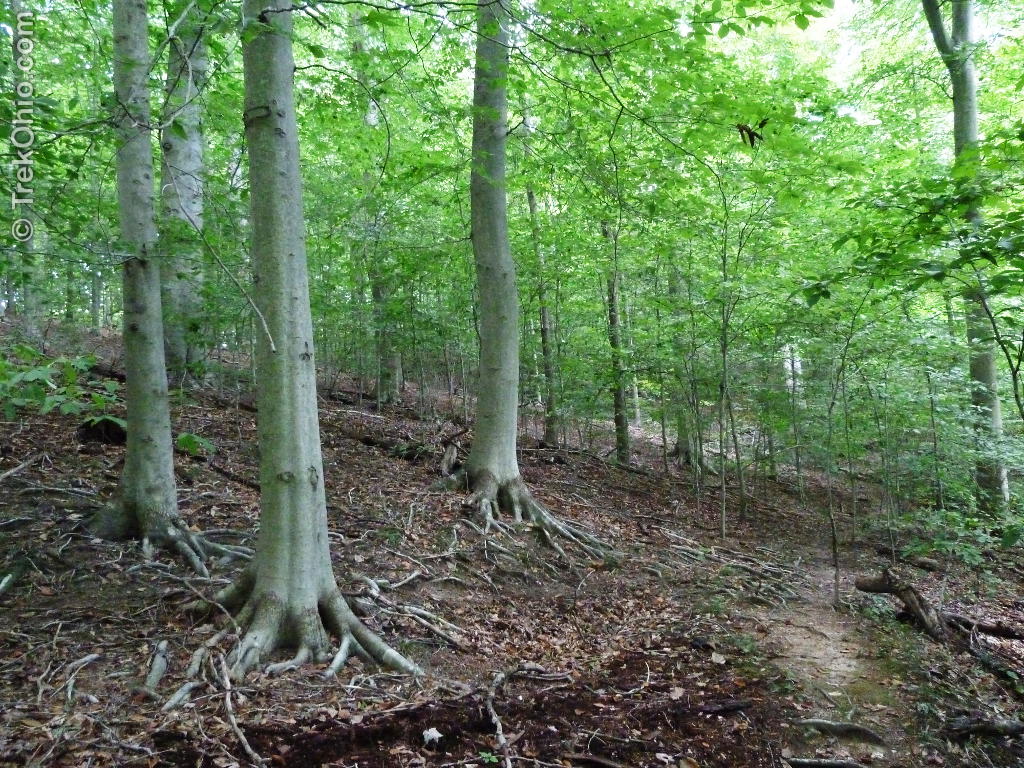
The structures that beechdrops develop to siphon off food from the beech tree could constrict the tree’s root if they were to continue to develop season after season. Fortunately beechdrops are an annual flower that completely die off every fall, so their parasitism does no serious damage to the tree. And we’ll close off by looking at the plant’s host, the American beech tree. You can recognize beech trees by their smooth, silver-gray bark.
Additional information
- Wikipedia: Epifagus americana (the Latin name for “Beechdrops”)
- West Virginia Division of Natural Resources: Beechdrops, PDF authored by Emily Grafton
- U.S.Forest Service: Mycotrophic Wildflowers – What are they? (about plants without chlorophyll that acquire their nourishment from fungi)
More on Plants without Chlorophyll
 One-flowered broomrape: a plant without chlorophyll
 Squawroot: An underground plant without leaves or chlorophyll
 Indian pipe: Another plant without chlorophyll

Deb Platt,
Thank you for this wonderful post. I’d read about parasitism, in an ecology class and the example given was a beech drop. However, there were no photo’s provided. Due to your post, I’ve realized I’m very familiar with seeing beech drops.
Best Regards, C
I’m glad the post was helpful, Curtis. Before I learned what Beech drops were, I had noticed them, but thought there were some sort of dead or dying plant.
Love these posts! Actually noticed a bunch of squaw root flowers earlier this year all because of your information! I’llkeep my eyes open for beechdrops now. 🙂
Thank you, Nancy. There is one other plant without chlorophyll I’d love to photograph, but I have yet to spot it (One-flowered broomrape). Despite not being green, the flowers can be quite colorful which surprises me.