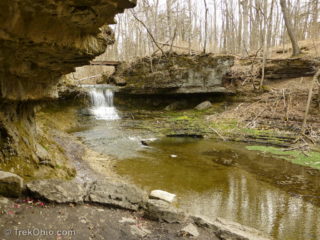
 Glen Helen began when alumnus Hugh Taylor Birch donated a wooded glen to Antioch College in 1925 in memory of his daughter, Helen. The college continued to acquire adjacent land over the years, and the Glen Helen Nature Preserve now encompasses 1000 acres and 25 miles of hiking trails. The preserve is managed by the Glen Helen Ecology Institute. Within the preserve there is a yellow spring that has given its name to the town where the college and preserve are located. The preserve also includes limestone Read more ➜
 Glen Helen Nature Preserve
Glen Helen began when alumnus Hugh Taylor Birch donated a wooded glen to Antioch College in 1925 in memory of his daughter, Helen. The college continued to acquire adjacent land over the years, and the Glen Helen Nature Preserve now encompasses 1000 acres and 25 miles of hiking trails. The preserve is managed by the Glen Helen Ecology Institute. Within the preserve there is a yellow spring that has given its name to the town where the college and preserve are located. The preserve also includes limestone Read more ➜ 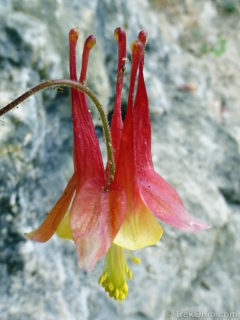 I was delighted at how many species of wildflower were in bloom at Fort Hill this past weekend. We saw many of the same flowers that appeared in April Wildflowers at Lake Katharine State Nature Preserve. So rather than posting duplicate flower photos, I'll just post ones that were newly seen at Fort Hill.
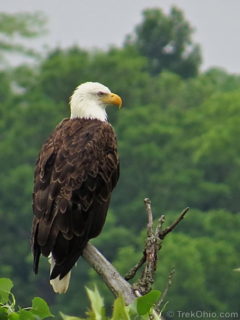 Located in Franklin and Delaware counties, Highbanks Metro Park is 1,159 acres in size with over 10 miles of hiking trail, including a 3.5 mile, mowed path that's available for dog walking and cross-country skiing. The park is bounded on one side by the Olentangy River, and it's crisscrossed by small streams flowing in ravines.
One of our favorite attractions is an observation deck that's perched on a shale bluff 110 feet above the Olentangy river. For a number of years a pair of eagles have nested
Located in Franklin and Delaware counties, Highbanks Metro Park is 1,159 acres in size with over 10 miles of hiking trail, including a 3.5 mile, mowed path that's available for dog walking and cross-country skiing. The park is bounded on one side by the Olentangy River, and it's crisscrossed by small streams flowing in ravines.
One of our favorite attractions is an observation deck that's perched on a shale bluff 110 feet above the Olentangy river. For a number of years a pair of eagles have nested 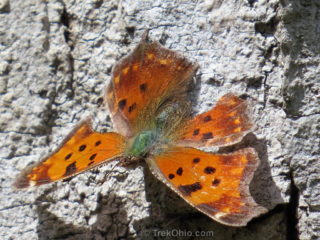 A short while ago I did a post on the Mourning Cloak butterfly. One of the odd things about this butterfly is that it looks like it only has four feet, but it actually has six feet like most insects. It's just that the front two are tiny, little things that the butterfly holds near its body. Someone thought the fuzzy, front feet looked like brushes, so that's how an entire family of butterfly species became known as the Brushfoot family. Today I'm going to look at two other species that are members
 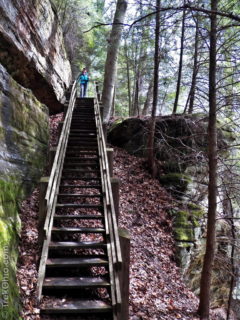 There are three trails at Lake Katharine. When we visited mid-April we hiked Salt Creek Trial and then Calico Bush Trail, but we didn't have time for the Pine Ridge Trail. The preserve struck us as being very scenic, and many spring flowers were in bloom during our visit. The Ohio Department of Natural Resources (ODNR) lists Lake Katharine as being one of the eight best preserves in the state for viewing spring wildflowers. The terrain is also interesting; it features many sandstone cliffs and outcroppings.
 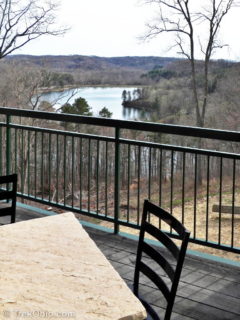 The dining lodge is one of the attractions of Lake Hope State Park. Originally built in 1950, the lodge burned to the ground in 2006. We visited Lake Hope State Parke several times after the lodge was destroyed, and it was a long drive to find a meal. Happily the lodge was rebuilt last year, and it has resumed serving those visiting and camping in the park as well as the local people of Vinton County. People can hire portions of the lodge for gatherings of all sorts, including conferences, weddings,
 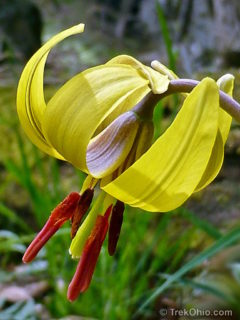 The Ohio Department of Natural Resources lists Lake Katharine State Nature Preserve as being one of the nine state nature preserves in Ohio that are among the best for seeing spring wildflowers. Having never been to this nature preserve in Jackson County, we decided to see what was blooming there in mid-April.
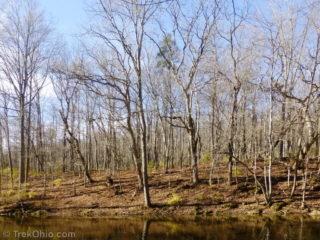 John Bryan State Park makes a great base for outdoor adventures in Greene County, Ohio. The 752-acre park has 11.4 miles of trail, most of which are adjacent to the Little Miami River. Plus it has an additional 6.5 miles of multi-use trails a short distance from the river that's open to both mountain bikers and hikers. If hiking and biking isn't enough fun, the park features one of the state's few public rock climbing and rappelling areas. And because the Little Miami River runs through the park,
 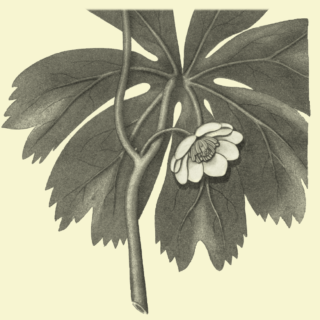 This post illustrates a couple of dozen, common species of spring wildflowers in Ohio. The scientific name in each caption links to an article where you can learn more about that species (a Wikipedia article, if possible). It also lists the months in which you can expect to see each species bloom in central Ohio. In southern Ohio they will bloom a little earlier and in northern Ohio a little later.
Cutleaf Toothwort
The photo below shows some of the foliage.
Mayapple
The blossom
This post illustrates a couple of dozen, common species of spring wildflowers in Ohio. The scientific name in each caption links to an article where you can learn more about that species (a Wikipedia article, if possible). It also lists the months in which you can expect to see each species bloom in central Ohio. In southern Ohio they will bloom a little earlier and in northern Ohio a little later.
Cutleaf Toothwort
The photo below shows some of the foliage.
Mayapple
The blossom 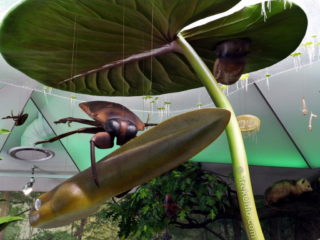 The F. A. Seiberling Nature Realm is a 104 acre Summit County Metro Park. The park has a large 10,000 sq. ft. nature center with exhibits detailing the natural history of the area.
The nature center includes an observation deck overlooking a pond and terrariums containing a number of Ohio reptiles and amphibians. The day we visited an individual associated with the park was introducing visitors to an Eastern Foxsnake (Elaphe gloydi).
There are two and
The F. A. Seiberling Nature Realm is a 104 acre Summit County Metro Park. The park has a large 10,000 sq. ft. nature center with exhibits detailing the natural history of the area.
The nature center includes an observation deck overlooking a pond and terrariums containing a number of Ohio reptiles and amphibians. The day we visited an individual associated with the park was introducing visitors to an Eastern Foxsnake (Elaphe gloydi).
There are two and