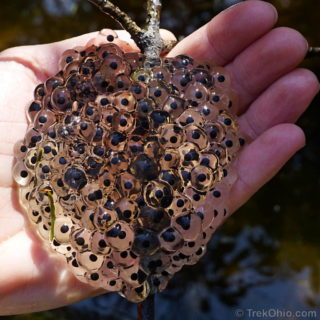
 After a walk at Wahkeena Nature Preserve, Bob and I stopped to chat with Robyn. Robyn is one of the naturalists at Wahkeena, and she was the original author of the Wahkeena Nature Preserve blog. Robyn asked us how our walk went. I mentioned that I had seen lots of amphibian eggs in pools of water, but I didn't know how to tell the difference between frog eggs and salamander eggs. She offered then and there to show us the difference.
We went to a little pool and Robyn lifted up two groups of eggs Read more ➜
After a walk at Wahkeena Nature Preserve, Bob and I stopped to chat with Robyn. Robyn is one of the naturalists at Wahkeena, and she was the original author of the Wahkeena Nature Preserve blog. Robyn asked us how our walk went. I mentioned that I had seen lots of amphibian eggs in pools of water, but I didn't know how to tell the difference between frog eggs and salamander eggs. She offered then and there to show us the difference.
We went to a little pool and Robyn lifted up two groups of eggs Read more ➜ Beginning of the amphibian life cycle
After a walk at Wahkeena Nature Preserve, Bob and I stopped to chat with Robyn. Robyn is one of the naturalists at Wahkeena, and she was the original author of the Wahkeena Nature Preserve blog. Robyn asked us how our walk went. I mentioned that I had seen lots of amphibian eggs in pools of water, but I didn't know how to tell the difference between frog eggs and salamander eggs. She offered then and there to show us the difference.
We went to a little pool and Robyn lifted up two groups of eggs Read more ➜ 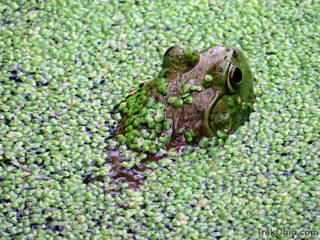 I had no idea how to tell whether a green frog was male or female, but now I do. And if you check out one of the off-site posts below, you'll know too. 🙂
See either:
https://naturallycuriouswithmaryholland.wordpress.com/2013/08/15/a-frogs-tympanum/, orhttps://sillyfrogsusan.wordpress.com/2012/04/20/nature-knowledge-frog-gender-id/
I had no idea how to tell whether a green frog was male or female, but now I do. And if you check out one of the off-site posts below, you'll know too. 🙂
See either:
https://naturallycuriouswithmaryholland.wordpress.com/2013/08/15/a-frogs-tympanum/, orhttps://sillyfrogsusan.wordpress.com/2012/04/20/nature-knowledge-frog-gender-id/
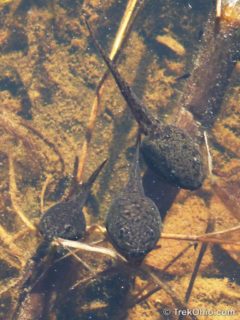 Whenever I'm at Inniswood Metro Gardens, I stop by to see what's happening in this tiny, municipal wetland. And right now, tadpoles are what's happening.
These two, very different types of tadpoles were co-existing in the pond. I wonder if they are different species of frog, or the same species born at different times?
Let's take a look at some prospective parents.
The happy threesome above are Eastern American Toads. You can distinguish toads from frogs because the skin
Whenever I'm at Inniswood Metro Gardens, I stop by to see what's happening in this tiny, municipal wetland. And right now, tadpoles are what's happening.
These two, very different types of tadpoles were co-existing in the pond. I wonder if they are different species of frog, or the same species born at different times?
Let's take a look at some prospective parents.
The happy threesome above are Eastern American Toads. You can distinguish toads from frogs because the skin 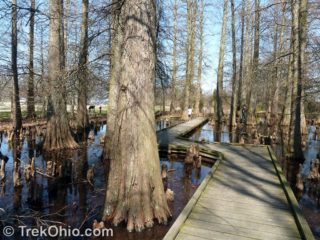 I decided to write this after visiting Jackson Bog State Nature Preserve and reading all the informative signs there... except they weren't all that informative for me because I didn't know my swamps from my bogs. So when I came home I decided to learn a few wetland basics.
Let's start with the easy stuff. In North America a wetland that has trees growing in it is called a swamp. That's why Dawes Arboretum referred to the following grove of trees as "Cypress Swamp".
A marsh
I decided to write this after visiting Jackson Bog State Nature Preserve and reading all the informative signs there... except they weren't all that informative for me because I didn't know my swamps from my bogs. So when I came home I decided to learn a few wetland basics.
Let's start with the easy stuff. In North America a wetland that has trees growing in it is called a swamp. That's why Dawes Arboretum referred to the following grove of trees as "Cypress Swamp".
A marsh 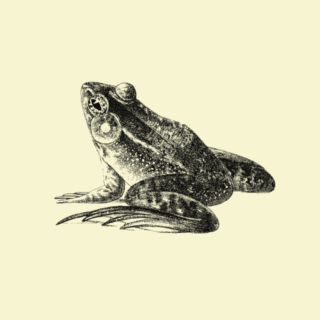 An article entitled, Ohio's Frog and Toad Species, states that there are 15 species in our state. To help me to learn to identify these species, I wanted to see photos of all 15 on one page. I selected a representative photo, but be aware that there can be a lot of variation in color for frogs of the same species. Below each photo, I note the range of colors that are possible for that species.
Toads
The "True" Toads
Eastern American Toad (Bufo americanus americanus)
The Eastern American
An article entitled, Ohio's Frog and Toad Species, states that there are 15 species in our state. To help me to learn to identify these species, I wanted to see photos of all 15 on one page. I selected a representative photo, but be aware that there can be a lot of variation in color for frogs of the same species. Below each photo, I note the range of colors that are possible for that species.
Toads
The "True" Toads
Eastern American Toad (Bufo americanus americanus)
The Eastern American 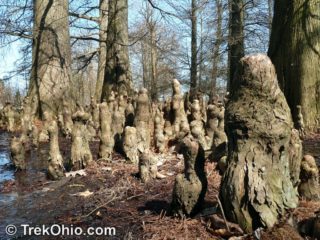 I always associated the bald-cypress pictured above with the bayous of the deep south. Imagine my surprise to learn that we have some growing in Central Ohio. It turns out that the mature bald-cypress (Taxodium distichum) is actually cold tolerant. You may be wondering why we aren't seeing them all over the place. Well, they can't reproduce naturally in this climate because the immature seedlings are susceptible to ice damage. But if you nurture the little seedlings in a greenhouse, then transplant