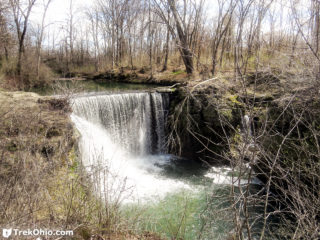
 Indian Mound Reserve is a 169-acre park that's managed by the Greene County park district. We were very favorably impressed by the park's historic and natural features. Among the historic features are:
Williamson Mound: a Native American, earthen mound constructed by the Adena culture between 500 B.C. and 100 A.D.
Pollock Works: a Native American, earthen wall constructed by the Hopewell culture between 100 B.C. and 500 A.D.
A historic log cabin that's currently being renovated
A dam created Read more ➜
Indian Mound Reserve is a 169-acre park that's managed by the Greene County park district. We were very favorably impressed by the park's historic and natural features. Among the historic features are:
Williamson Mound: a Native American, earthen mound constructed by the Adena culture between 500 B.C. and 100 A.D.
Pollock Works: a Native American, earthen wall constructed by the Hopewell culture between 100 B.C. and 500 A.D.
A historic log cabin that's currently being renovated
A dam created Read more ➜ Indian Mound Reserve
Indian Mound Reserve is a 169-acre park that's managed by the Greene County park district. We were very favorably impressed by the park's historic and natural features. Among the historic features are:
Williamson Mound: a Native American, earthen mound constructed by the Adena culture between 500 B.C. and 100 A.D.
Pollock Works: a Native American, earthen wall constructed by the Hopewell culture between 100 B.C. and 500 A.D.
A historic log cabin that's currently being renovated
A dam created Read more ➜ 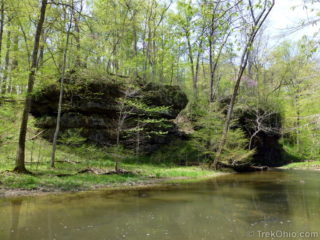 Two thousand years ago, the Hopewell people built a massive earthwork enclosing a 40-acre hilltop in southwest Ohio. This earthwork which resembles a fort was later dubbed Fort Hill.
Today Fort Hill is a 1,200 acre preserve owned by the Ohio Historical Society and operated by the Arc of Appalachia Preserve System. The preserve features 11 miles of hiking trails, a small museum, a parking area, picnic shelters, and rest rooms.
Fort Trail
We visited the preserve last September
Two thousand years ago, the Hopewell people built a massive earthwork enclosing a 40-acre hilltop in southwest Ohio. This earthwork which resembles a fort was later dubbed Fort Hill.
Today Fort Hill is a 1,200 acre preserve owned by the Ohio Historical Society and operated by the Arc of Appalachia Preserve System. The preserve features 11 miles of hiking trails, a small museum, a parking area, picnic shelters, and rest rooms.
Fort Trail
We visited the preserve last September 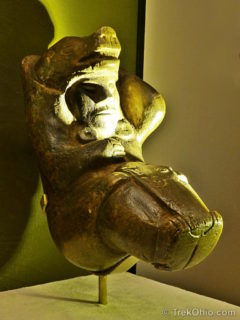 When looking at the prehistoric artefacts and earthen structures in Ohio, I'm always wondering what meanings these things held for the people who created them. I end up reading whatever explanatory sign is posted nearby, but while I'm doing so I'm also wondering how anthropologists know any of this stuff. Since prehistoric societies don't leave any texts explaining themselves or their culture, anthropologists have to be making a lot of inferences.
However when I was at Serpent Mound
When looking at the prehistoric artefacts and earthen structures in Ohio, I'm always wondering what meanings these things held for the people who created them. I end up reading whatever explanatory sign is posted nearby, but while I'm doing so I'm also wondering how anthropologists know any of this stuff. Since prehistoric societies don't leave any texts explaining themselves or their culture, anthropologists have to be making a lot of inferences.
However when I was at Serpent Mound 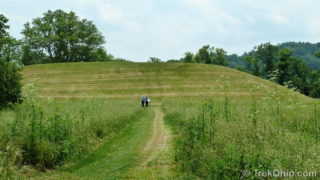 Seip Mound State Memorial Park is one of the five noncontiguous sites that make up the Hopewell Culture National Historical Park. The other four sites are Hopeton Earthworks, Hopewell Mound Group, High Banks Works, and the Mound City Group (reviewed by us here). Native Americans belonging to the Hopewell tradition constructed this mound sometime between 100 B.C. – A.D. 400.
The mound pictured above was part of a larger earthworks complex. At a number of sites in Ohio, Native Americans
Seip Mound State Memorial Park is one of the five noncontiguous sites that make up the Hopewell Culture National Historical Park. The other four sites are Hopeton Earthworks, Hopewell Mound Group, High Banks Works, and the Mound City Group (reviewed by us here). Native Americans belonging to the Hopewell tradition constructed this mound sometime between 100 B.C. – A.D. 400.
The mound pictured above was part of a larger earthworks complex. At a number of sites in Ohio, Native Americans 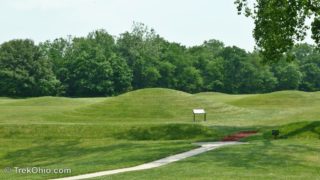 What's known as the "Mound City Group" is part of the Hopewell Culture National Historical Park in Ross County, Ohio. This land was used for funeral rituals by a Native American civilization that flourished between 200 B.C. and 500 A.D. Mound City is approximately 13 acres in size. A low earthen wall about 3 to 4 feet high (1 to 1.3 meters) lies around the perimeter; it's shape is that of a square with rounded corners. Perhaps the builders of the Mound City thought of the wall as a "sacred enclosure"
 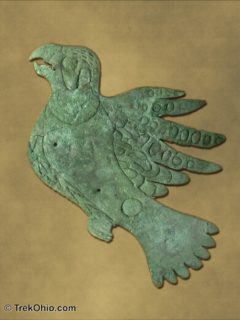 The "Hopewell Culture" refers to a Native American civilization that was centered in Ohio. It flourished here between 200 B.C. and 500 A.D. They are renowned for having built elaborate, huge, earthen structures. However when these mounds were excavated, many artifacts of great artistry were discovered. I would like to share photos of a few of these artifacts, or in some case, replicas of these artifacts. All of them were uncovered at "Mound City" which is where the Hopewell Culture National Historical
  Overview
The Newark Earthworks were constructed about 2000 years ago by the prehistoric, Hopewell people. These are the largest, geometric earthworks in the world. To give you a better sense of the size and shape of these structures, it's best to look at an aerial view. Since I can't take aerial photos myself, I photographed some of the interpretive signs near the earthworks.
The plaque below shows the layout of the Newark Earthworks which occupy four square miles (10.6 square kilometers).
I
Overview
The Newark Earthworks were constructed about 2000 years ago by the prehistoric, Hopewell people. These are the largest, geometric earthworks in the world. To give you a better sense of the size and shape of these structures, it's best to look at an aerial view. Since I can't take aerial photos myself, I photographed some of the interpretive signs near the earthworks.
The plaque below shows the layout of the Newark Earthworks which occupy four square miles (10.6 square kilometers).
I