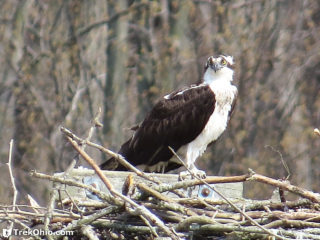
 Earlier this week we stopped by the Hoover Mudflats Boardwalk to view the osprey nesting platforms. We had been checking the platforms on and off for a few weeks, and they had been completely bare. But to our delight when we went to the boardwalk this week, both platforms had nests.
We weren't there long when the osprey on the nesting platform began calling to its mate. And soon after we spotted its mate flying back toward the nest with a fish in its talons.
We watched with Read more ➜
Earlier this week we stopped by the Hoover Mudflats Boardwalk to view the osprey nesting platforms. We had been checking the platforms on and off for a few weeks, and they had been completely bare. But to our delight when we went to the boardwalk this week, both platforms had nests.
We weren't there long when the osprey on the nesting platform began calling to its mate. And soon after we spotted its mate flying back toward the nest with a fish in its talons.
We watched with Read more ➜ An Osprey Sharing Its Catch… or Maybe Not
Earlier this week we stopped by the Hoover Mudflats Boardwalk to view the osprey nesting platforms. We had been checking the platforms on and off for a few weeks, and they had been completely bare. But to our delight when we went to the boardwalk this week, both platforms had nests.
We weren't there long when the osprey on the nesting platform began calling to its mate. And soon after we spotted its mate flying back toward the nest with a fish in its talons.
We watched with Read more ➜ 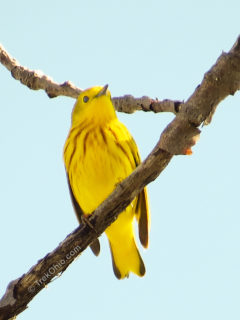 The Biggest Week in American Birding is an annual event held in northwestern Ohio. This year it is being held from May 6 to May 15, 2016. Every spring many species of small birds in the warbler family migrate from South America to Canada. In order to store up energy for the flight across Lake Erie, the birds spend some time on the southwestern shore of Lake Erie fattening up on insects. While the birds look for insects, the people look for the birds. We've participated in two previous Biggest Weeks
 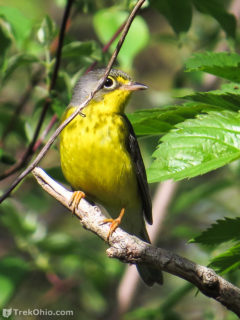 Last week we went to Magee Marsh to check out the action at the Biggest Week in American Birding. This was the second time we made an appearance (the first time is described here). This event is set up to celebrate and observe the migration of warblers in their colorful breeding plumage. Many species are on their way north, but their trip is delayed by Lake Erie. Before these small birds attempt to fly over the lake, they stop on Lake Erie's southern shore to fatten up on bugs, so they'll have the
 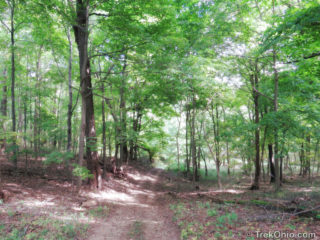 Ramser Arboretum is a 680-acre arboretum in Knox County that is privately-owned, but open to the public (except during deer-gun season). It features more than five miles of hiking trails that may be used by cross country skiers during the winter.
The entrance contains a gravel parking lot, picnic tables, a port-a-potty and a kiosk with information and post cards with a map of the trails. A relatively short drive from Columbus (30-40 minutes), Ramser is a nice spot for a walk in the
Ramser Arboretum is a 680-acre arboretum in Knox County that is privately-owned, but open to the public (except during deer-gun season). It features more than five miles of hiking trails that may be used by cross country skiers during the winter.
The entrance contains a gravel parking lot, picnic tables, a port-a-potty and a kiosk with information and post cards with a map of the trails. A relatively short drive from Columbus (30-40 minutes), Ramser is a nice spot for a walk in the 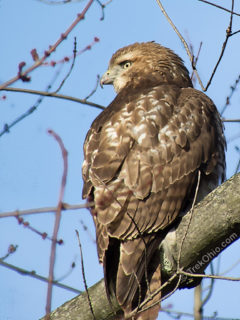 On New Year's Day we went on our first hike of the year: a birding hike at Blacklick Woods Metro Park. About twenty people joined a park naturalist, Colleen, for the two-mile hike. If you're beginning birders like us, it's really helpful to join up with a group such as this. On a number of occasions the naturalist or other members of the group pointed out birds that I'm sure I would have missed otherwise. We also learned some of the places that certain species of bird like to frequent, so when we
 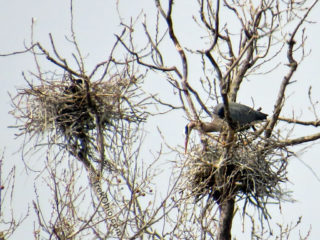 Last month in Delaware County, naturalist Kim Banks held a special program on great blue herons. Mated pairs of these herons nest very close to one another in what's called a heronry. Participants then drove from Deer Haven Preserve (one of the county parks) to a nearby Liberty Township preserve known as Smith Preserve at Olentangy Falls. It turns out that there is a sizable heronry there. I returned just last week to see how things were developing.
Smith Preserve offers no trails
Last month in Delaware County, naturalist Kim Banks held a special program on great blue herons. Mated pairs of these herons nest very close to one another in what's called a heronry. Participants then drove from Deer Haven Preserve (one of the county parks) to a nearby Liberty Township preserve known as Smith Preserve at Olentangy Falls. It turns out that there is a sizable heronry there. I returned just last week to see how things were developing.
Smith Preserve offers no trails 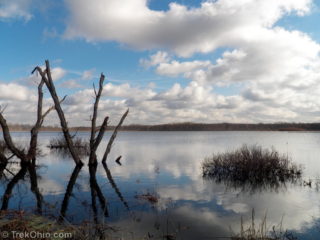 Killbuck Marsh is a 5,761-acre wildlife area in Wayne and Holmes counties located near the town of Wooster. It is the largest marsh outside of the northern Lake Erie region; over half its acreage is wetland.
The Wildlife Area
A section of the wildlife area is designated as a wildlife refuge and is off-limits to visitors. The remainder is available for hunters (during hunting season) and fishermen. There are a couple of short trails and numerous scattered parking areas and pull-offs
Killbuck Marsh is a 5,761-acre wildlife area in Wayne and Holmes counties located near the town of Wooster. It is the largest marsh outside of the northern Lake Erie region; over half its acreage is wetland.
The Wildlife Area
A section of the wildlife area is designated as a wildlife refuge and is off-limits to visitors. The remainder is available for hunters (during hunting season) and fishermen. There are a couple of short trails and numerous scattered parking areas and pull-offs 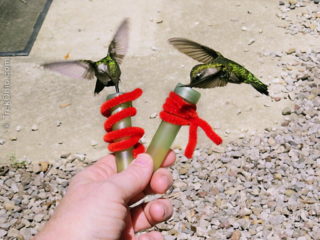 The Nature Center at Lake Hope State Park is well-known as the place to go if you want to try hand-feeding hummingbirds. This seasonal activity typically begins in July. This year park officials will continue to host the hand-feeding sessions on Thursday through Sunday from 1 to 3 PM until Labor Day.
This was the first time Bob and I had tried hand-feeding hummingbirds, and we both loved it. It is fascinating to watch hummingbirds perform their aerial acrobatics, but it was even more amazing to
The Nature Center at Lake Hope State Park is well-known as the place to go if you want to try hand-feeding hummingbirds. This seasonal activity typically begins in July. This year park officials will continue to host the hand-feeding sessions on Thursday through Sunday from 1 to 3 PM until Labor Day.
This was the first time Bob and I had tried hand-feeding hummingbirds, and we both loved it. It is fascinating to watch hummingbirds perform their aerial acrobatics, but it was even more amazing to 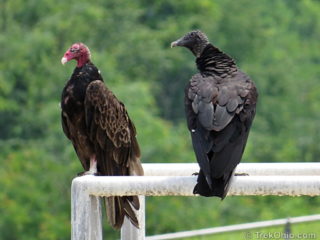 In the New World there are seven species of birds that belong to the vulture family. Three of these species are present in the United States: the Turkey Vulture, the Black Vulture, and the California Condor. Two of these three are present in Ohio: the Turkey Vulture and the Black Vulture.
Finding Food
The most noticeable difference between the two species is the color of the head: red for Turkey vultures and dark gray for the Black vulture. The bills are also colored differently.
In the New World there are seven species of birds that belong to the vulture family. Three of these species are present in the United States: the Turkey Vulture, the Black Vulture, and the California Condor. Two of these three are present in Ohio: the Turkey Vulture and the Black Vulture.
Finding Food
The most noticeable difference between the two species is the color of the head: red for Turkey vultures and dark gray for the Black vulture. The bills are also colored differently. 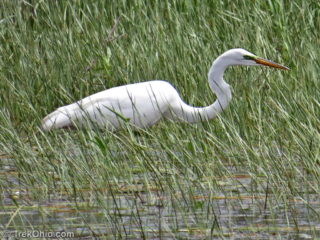 The Ottawa National Wildlife Refugee is located next to Lake Erie between Magee Marsh and Metzger Marsh. It is a great place to go birding because it is another stop-over during the spring / fall bird migration, particularly for water birds in the spring. It's also a nesting / hunting area for local eagles.
Entrance to the refuge is off of State Route 2 in Ottawa County. The visitors center features a small exhibit area, conference rooms, maps of the refuge, restrooms, and a telescope
The Ottawa National Wildlife Refugee is located next to Lake Erie between Magee Marsh and Metzger Marsh. It is a great place to go birding because it is another stop-over during the spring / fall bird migration, particularly for water birds in the spring. It's also a nesting / hunting area for local eagles.
Entrance to the refuge is off of State Route 2 in Ottawa County. The visitors center features a small exhibit area, conference rooms, maps of the refuge, restrooms, and a telescope