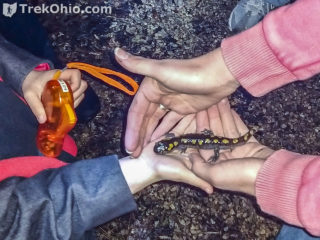
 From late February and through the end of March salamanders migrate to their breeding sites. Many amphibian species only breed in vernal pools. Such pools form during the winter, remain throughout the spring, then dry up in the summer. Since the water does not remain in the pool year-long, fish cannot live in them. This means that amphibian eggs, larvae, and/or tadpoles will not be eaten up by fish.
On February 23rd we attended an evening event at the Wahkeena Nature Preserve in Fairfield Read more ➜
From late February and through the end of March salamanders migrate to their breeding sites. Many amphibian species only breed in vernal pools. Such pools form during the winter, remain throughout the spring, then dry up in the summer. Since the water does not remain in the pool year-long, fish cannot live in them. This means that amphibian eggs, larvae, and/or tadpoles will not be eaten up by fish.
On February 23rd we attended an evening event at the Wahkeena Nature Preserve in Fairfield Read more ➜ Salamanders and newts at their breeding sites
From late February and through the end of March salamanders migrate to their breeding sites. Many amphibian species only breed in vernal pools. Such pools form during the winter, remain throughout the spring, then dry up in the summer. Since the water does not remain in the pool year-long, fish cannot live in them. This means that amphibian eggs, larvae, and/or tadpoles will not be eaten up by fish.
On February 23rd we attended an evening event at the Wahkeena Nature Preserve in Fairfield Read more ➜ 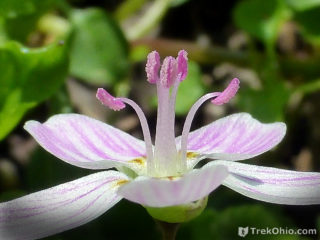 Here's a sample of some of the wildflowers that have caught my eye while hiking this spring. I have organized them here into several groups based on what period in the spring then tend to bloom: Late March to Early April, Mid-April, and Late April to Early May. Flowers in the last (and largest) group are still blooming.
By clicking any of the photos below, you can look at a larger resolution of the photo. Once you are viewing a larger version, you can also use your arrow keys to move between photos.
Late
Here's a sample of some of the wildflowers that have caught my eye while hiking this spring. I have organized them here into several groups based on what period in the spring then tend to bloom: Late March to Early April, Mid-April, and Late April to Early May. Flowers in the last (and largest) group are still blooming.
By clicking any of the photos below, you can look at a larger resolution of the photo. Once you are viewing a larger version, you can also use your arrow keys to move between photos.
Late 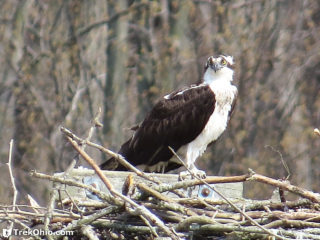 Earlier this week we stopped by the Hoover Mudflats Boardwalk to view the osprey nesting platforms. We had been checking the platforms on and off for a few weeks, and they had been completely bare. But to our delight when we went to the boardwalk this week, both platforms had nests.
We weren't there long when the osprey on the nesting platform began calling to its mate. And soon after we spotted its mate flying back toward the nest with a fish in its talons.
We watched with
Earlier this week we stopped by the Hoover Mudflats Boardwalk to view the osprey nesting platforms. We had been checking the platforms on and off for a few weeks, and they had been completely bare. But to our delight when we went to the boardwalk this week, both platforms had nests.
We weren't there long when the osprey on the nesting platform began calling to its mate. And soon after we spotted its mate flying back toward the nest with a fish in its talons.
We watched with 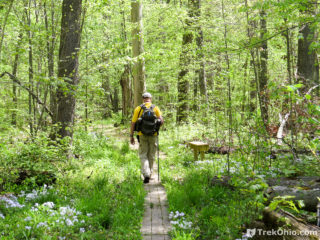 Goll Woods State Nature Preserve is a 321-acre preserve in Fulton County with 5.25 miles of trail. The trail system approaches the Tiffin River in two places, and it also passes by the Goll Cemetery and the preserve office for the Northwest Preserve District. One hundrd acres of the preserve are old growth forest (sometimes referred to as "virgin woods"). Some of the trees in this region are up to 400 years old and have reached a diameter of 4 feet. Among the largest trees are bur oak, white oak,
 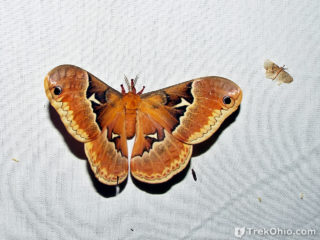 Mothapalooza is an annual conference sponsored by the Ohio Division of Wildlife. As its name suggests, the focus on the conference is on moths. Just like people who go bird-watching are said to go "birding," people who are on the lookout for moths are said to go "mothing." The conference is geared both toward the mothing enthusiast and the beginner. Activities included daytime field trips, in-house talks, and night-time moth viewings. Some of the daytime field-trips delved into other topics besides
  The photos below are a sample of some of the wildflowers we've seen in June, July, and August. All were photographed in Ohio.
Native Orchids
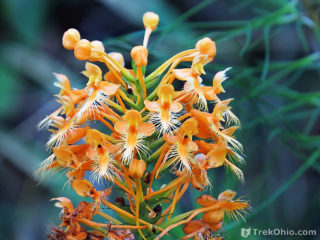
I had the good fortune of seeing two, new species of native orchid for the first time while we were attending Mothapalooza. Mothapalooza is an annual conference held in Ohio that focuses on moths, but also deals with nature more generally. The most colorful of the two was the Yellow-fringed orchid.
Although mostly pale, the following orchid
The photos below are a sample of some of the wildflowers we've seen in June, July, and August. All were photographed in Ohio.
Native Orchids
I had the good fortune of seeing two, new species of native orchid for the first time while we were attending Mothapalooza. Mothapalooza is an annual conference held in Ohio that focuses on moths, but also deals with nature more generally. The most colorful of the two was the Yellow-fringed orchid.
Although mostly pale, the following orchid 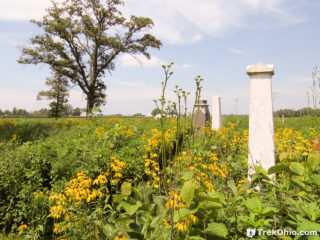 Last summer we visited two of Ohio's smallest state nature preserves: Bigelow Cemetery and Smith Cemetery. Within these two preserves are remnants of prairie that once extended over 5% of Ohio. Because both sites were 19th century cemeteries, they were undisturbed by the plowing that converted 99% of this rich, prairie soil into Ohio farmland. Today I will discuss the half-acre Bigelow Cemetery State Nature Preserve, and I'll save the nearby Smith Cemetery State Nature Preserve for a later post.
 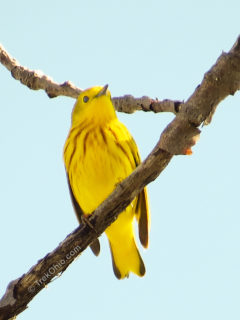 The Biggest Week in American Birding is an annual event held in northwestern Ohio. This year it is being held from May 6 to May 15, 2016. Every spring many species of small birds in the warbler family migrate from South America to Canada. In order to store up energy for the flight across Lake Erie, the birds spend some time on the southwestern shore of Lake Erie fattening up on insects. While the birds look for insects, the people look for the birds. We've participated in two previous Biggest Weeks
 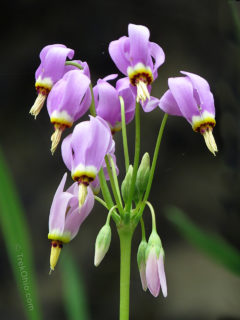 Here a sampling of the wildflowers that I saw in March and April of this year. With each photo below, I've identified the flower and indicated when and where it was photographed. I'm leading off with a flower called Pride of Ohio out of Buckeye pride. 🙂 It is also known as Shooting Star.
Additional information
If you liked this article, you might be interested in our post, Common Spring
Here a sampling of the wildflowers that I saw in March and April of this year. With each photo below, I've identified the flower and indicated when and where it was photographed. I'm leading off with a flower called Pride of Ohio out of Buckeye pride. 🙂 It is also known as Shooting Star.
Additional information
If you liked this article, you might be interested in our post, Common Spring 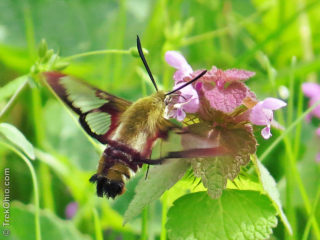 This little creature is my favorite moth. It's common name is actually the hummingbird clearwing moth (Hemaris thysbe). When I first saw one, I actually thought that I was seeing a hummingbird flitting about from flowers. But then I noticed the antenna.
In the above photo, you can see right through the moth's wings, hence the name "clearwing." However when it first emerged from its cocoon, the wings were a solid, dark red similar in color to the border of the wings seen above. The
This little creature is my favorite moth. It's common name is actually the hummingbird clearwing moth (Hemaris thysbe). When I first saw one, I actually thought that I was seeing a hummingbird flitting about from flowers. But then I noticed the antenna.
In the above photo, you can see right through the moth's wings, hence the name "clearwing." However when it first emerged from its cocoon, the wings were a solid, dark red similar in color to the border of the wings seen above. The